
Introduction
Sourcing lurex glitter knit fabric involves more than choosing the right shine, weight, or stretch. Because metallic yarns are sensitive to tension, dyeing, finishing, and chemical handling, weak supply chain controls can quickly turn into quality failures, shipment delays, or compliance problems. This article explains why supply chain security matters specifically for lurex fabrics and what changes when you work with a certified factory in China. You’ll see how certification, traceability, and process consistency help protect fabric performance, reduce sourcing risk, and support more reliable production planning before moving into the key risks and evaluation criteria.
Why Supply Chain Security Matters When Sourcing Lurex Fabric
If you have ever been in the trenches of textile sourcing, you already know that buying specialized materials is rarely simple. Sourcing metallic knits requires a completely different level of vigilance compared to standard cottons or polyesters. Supply chain security isn’t just a corporate buzzword; it is the absolute backbone of a profitable fashion or performance-wear line.
When dealing with specialty textiles, a single misstep in the supply chain can lead to disastrous production delays, ruined brand reputation, or compliance nightmares at customs. Partnering with a highly vetted, certified Lurex glitter knit fabric supplier mitigates these issues. A secure supply chain means you know exactly where your yarn comes from, how it is dyed, and that the factory floor operates under strict, verifiable standards.
Key Risks in Lurex Fabric Sourcing
The biggest headache with unverified suppliers is the physical integrity of the metallic yarn itself. Lurex and similar metallic threads are notoriously finicky; if the knitting machine tension is off by even a fraction, the metallic foil snaps, leading to a fabric that feels scratchy and looks inconsistent. Entire 1,000-yard batches can be rejected because a factory used cheap, brittle metallic yarns that cannot survive a standard wash cycle.
Beyond durability, there are severe chemical risks. Unregulated dyeing and finishing processes often rely on harsh chemicals to set the glitter effect. Without careful oversight, you might end up with fabric containing formaldehyde levels exceeding the strict 75 ppm (parts per million) limit for direct skin contact, or azo dyes that are outright banned in the EU and US markets. Sourcing from a blind spot in the supply chain means you absorb 100% of these risks.
Market Pressures Driving Certified Supply Chains
The modern textile market no longer allows for cutting corners. Fast fashion demands incredible speed, often pushing lead times down from a traditional 60 days to a blistering 25 to 30 days. Simultaneously, consumers and regulatory bodies are demanding radical transparency. You cannot sacrifice sustainability for speed. This immense pressure makes working within certified supply chains essential.
Brands are now required to prove their ESG (Environmental, Social, and Governance) compliance. If a factory cannot provide an OEKO-TEX Standard 100 certificate or a valid ISO 9001 audit, major retailers simply won’t stock the garments. The market is aggressively weeding out middlemen and non-compliant workshops, pushing serious buyers directly toward certified, vertically integrated factories that control the process from yarn extrusion to final inspection.
Section Summary & Comparative Data: Sourcing data shows that uncertified supply chains typically suffer a defect rate of 8% to 12%, often failing chemical compliance tests (e.g., formaldehyde > 75 ppm). In stark contrast, a fully certified supply chain drives defect rates down to 1.5% to 2%, ensuring 100% compliance with global skin-safety standards while maintaining the 30-day rapid lead times the market demands.
What to Verify in a Certified Lurex Fabric Factory
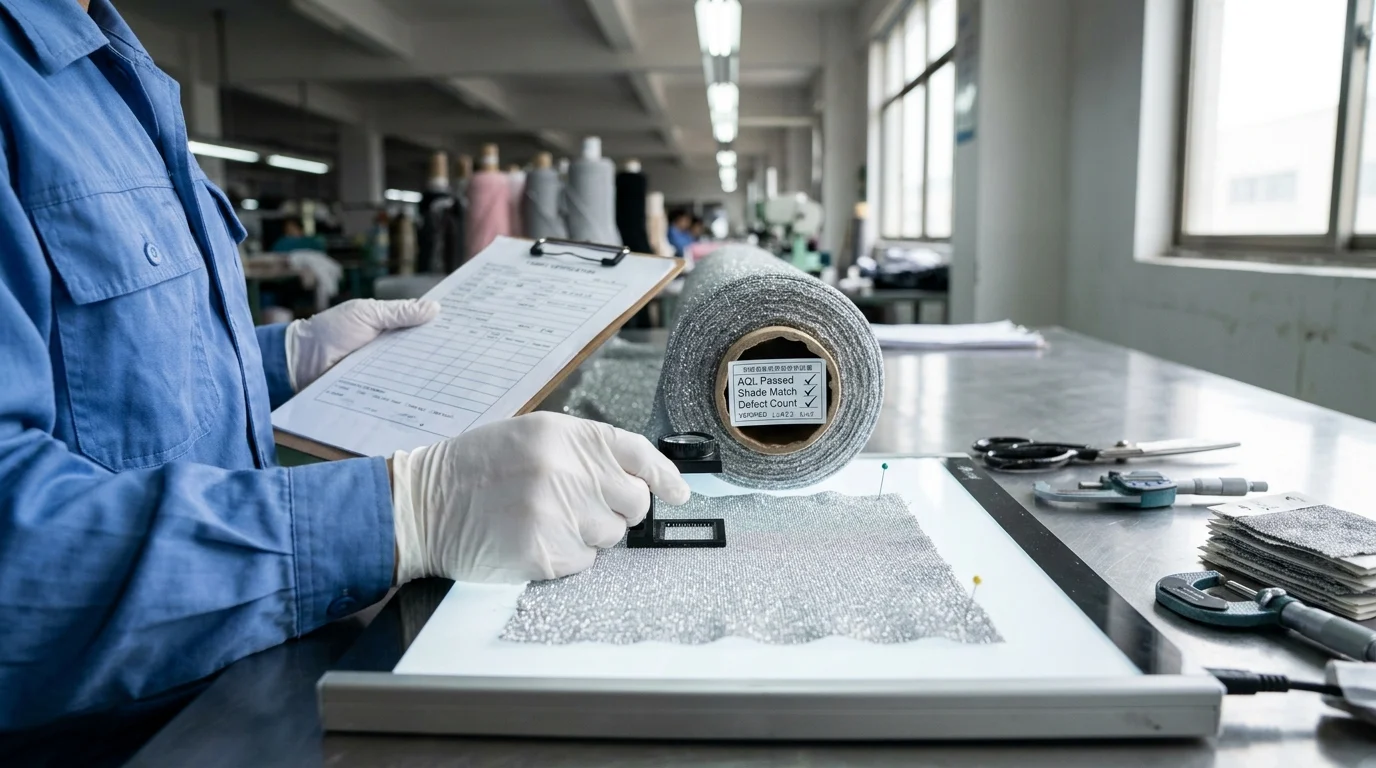
When evaluating a China lurex fabric factory, a beautiful showroom means nothing if the production floor is a chaotic mess. Verifying a factory requires digging into their technical specifications, paper trail, and daily operational habits.
The initial assessment should focus on how they handle raw materials and testing equipment. A certified factory won’t just promise good quality; they will demonstrate the exact lab equipment used to measure colorfastness, stretch recovery, and chemical safety before a single roll is loaded onto a shipping container.
Product Specifications and Quality Control
The first audit point is the factory’s adherence to product specifications. Metallic knits require precise weight and width controls, typically demanding a consistent GSM (grams per square meter) variance of no more than +/- 5%. For an order of 220 GSM fabric with a 58/60 inch cuttable width, inline quality control (QC) inspectors must be seen measuring rolls straight off the stenter frame.
Colorfastness is another major hurdle. Glitter and metallic yarns are prone to bleeding or losing their luster, requiring a minimum Grade 4 for both washing and dry rubbing colorfastness. Additionally, shrinkage records are vital. A premium knit should have a shrinkage rate of less than 5% after a standard wash. A factory lacking an in-house lab to run these tests daily is a massive red flag.
Certification, Traceability, and Testing Systems
Documentation separates real manufacturers from pretenders. It is crucial to request certificates and verify the certificate numbers online. ISO 9001 for quality management is the baseline. Beyond that, OEKO-TEX Standard 100 is non-negotiable for apparel, ensuring that heavy metals like lead are kept strictly below 90 ppm.
Traceability is equally critical. If a fabric fails a test, the factory must have a system to trace that specific roll back to the exact dye lot and knitting machine operator. Look for ERP (Enterprise Resource Planning) systems and barcode tagging on the fabric rolls. If a factory is still tracking lots with handwritten paper tags that easily fall off, their traceability is practically zero.
Example of Strong vs Weak Factory Compliance
To make this concrete, comparing a robust factory against a weak one reveals stark differences, usually obvious within the first hour of an audit.
| Metric | Strong Certified Factory | Weak/Uncertified Factory |
|---|---|---|
| In-House Testing | Full lab (Colorfastness, Shrinkage, Rubbing) | None (Relies entirely on third-party or guesswork) |
| Defect Rate Tolerance | Strictly < 2% | Often 8% – 10% |
| Traceability | Barcoded ERP system per roll | Handwritten tags, easily lost |
| Chemical Compliance | OEKO-TEX certified (Lead < 90ppm) | No valid certificates provided |
| Shrinkage Control | < 5% variance | 8% – 12% variance |
Section Summary & Comparative Data: The data speaks for itself when verifying these facilities. A strong, certified factory maintains strict tolerances: <5% shrinkage, >Grade 4 colorfastness, and <2% overall defect rates. Conversely, weak factories frequently hit 10% shrinkage and fail basic 90 ppm lead threshold tests, proving that investing time in auditing completely changes your risk profile.
How to Compare Lurex Fabric Suppliers
Comparing suppliers is an art and a science. When evaluating a new B2B wholesale textile factory, decisions should never be based solely on the quoted price per yard. The cheapest quote often ends up being the most expensive option once you factor in delays, high minimums, and rejected goods.
To truly compare suppliers, evaluate their operational flexibility. How fast can they spin up a sample? What is their true production capacity? Most importantly, do they actually understand the end-use of the fabric, or are they just blindly churning out yardage?
MOQ, Pricing, and Lead Time Comparison
The three biggest levers in supplier comparison are Minimum Order Quantity (MOQ), pricing tiers, and lead times. Trading companies might offer low MOQs, but their prices are inflated and they don’t control the schedule. Direct factories give better prices but sometimes demand massive MOQs. The sweet spot is a Tier-1 factory that understands the need for manageable MOQs without punishing you on price.
| Supplier Type | Typical MOQ | Est. Price/Yard (200 GSM) | Bulk Lead Time | Pros / Cons |
|---|---|---|---|---|
| Trading Company | 100 – 300 kg | $4.50 – $5.50 | 30 – 40 days | Pro: Low MOQ / Con: High price, low control |
| Tier-2 Factory | 1,000+ kg | $3.20 – $3.80 | 35 – 45 days | Pro: Cheap / Con: Inflexible, slow |
| Tier-1 Certified Factory | 500 kg | $3.50 – $4.20 | 15 – 25 days | Pro: Fast, high quality, balanced MOQ / Con: Strict scheduling |
Finding a Tier-1 partner who offers a 500 kg MOQ with a 15 to 20-day turnaround provides a significant advantage. It allows brands to stay agile without eating massive inventory costs.
Factory Capabilities and Sampling Speed
A factory’s true capability is often revealed during the sampling phase. A custom lab dip for a new metallic knit should arrive within 5 to 7 days. If a supplier takes three weeks just to send a color swatch, bulk production will likely face severe delays.
Machinery is another critical factor. High-quality Lurex knits require fine-gauge circular knitting machines, typically 28G or 32G, to ensure the metallic yarn is seamlessly integrated without creating a rough surface. A supplier with a modern, well-maintained machine park can switch between custom jacquards and standard solids rapidly, vastly improving sampling speed.
Use Cases in Fashion and Performance Wear
Not all metallic knits are created equal, and the supplier must understand the difference in use cases. When sourcing for evening wear, the drape and the visual pop of the glitter are paramount. The fabric might only need 3% to 5% spandex.
However, for performance wear or dancewear, the fabric needs high multidirectional stretch and exceptional recovery. This requires 8% to 12% spandex content, and the metallic yarn must withstand intense physical stress without snapping. A top-tier supplier will actively advise on the yarn composition based on the tech pack.
Section Summary & Comparative Data: When comparing suppliers, the data points clearly favor agile, Tier-1 factories. You are looking at a sweet spot of 500 kg MOQs and 15-25 day lead times at $3.50-$4.20/yard, compared to the rigid 1,000+ kg MOQs and 40-day waits of lower-tier competitors. Furthermore, sampling speeds of 5-7 days versus the industry average of 14-21 days drastically accelerate your time-to-market.
How to Build a Safer Lurex Fabric Sourcing Process

Once a Certified fabric manufacturer is identified, the work is just beginning. Building a safer sourcing process means establishing a rigid, repeatable workflow that leaves zero room for miscommunication.
Treating every order as a collaborative project with the factory is essential. By setting clear expectations from the very first inquiry down to the final shipping document, you build a protective moat around the supply chain. Here is how to structure that process.
Step-by-Step Workflow From Inquiry to Order
The workflow starts with a highly detailed tech pack. Never just ask for a generic “silver glitter knit.” Specify the exact Pantone colors, the yarn composition (e.g., 85% Polyester, 10% Metallic, 5% Spandex), the target GSM, and the acceptable tolerances. A detailed quotation should follow within 24 hours.
Next comes the lab dip phase, which should take 3 to 5 days. Once the color is approved, move to a strike-off or a small sample yardage run (usually 10-20 yards). Only after physically inspecting and approving this sample should the bulk production phase be triggered. By locking down the specs early, bulk production can smoothly execute within a tight 20 to 25-day window without any panicked revisions.
Logistics, Delivery Planning, and Documentation
Logistics can easily kill margins if not planned correctly. Negotiating FOB (Free On Board) terms from major ports like Shanghai or Ningbo provides control over the freight forwarder. For bulk orders, ocean freight to the US West Coast typically takes 25 to 30 days, while air freight for urgent drops takes 5 to 7 days but costs significantly more.
Documentation must be flawless. A single typo on a commercial invoice can stall a shipment at customs for weeks. Require the factory to provide a draft of the Bill of Lading, the Commercial Invoice, the Packing List, and the Certificate of Origin at least 5 days before the vessel departs. This gives the customs broker ample time to clear the goods pre-arrival.
Benefits of Long-Term Factory Partnerships
The ultimate goal of this process is to stop supplier-hopping and build a long-term partnership. Working with the same factory season after season creates incredible efficiencies. They learn your quality standards, start pre-booking machine time for anticipated orders, and often hold greige (undyed) fabric in stock.
Financially, the benefits are substantial. A stable partnership typically yields a 5% to 10% cost reduction over two years due to volume discounts and optimized communication. More importantly, on-time delivery rates skyrocket.
Section Summary & Comparative Data: A structured workflow is the ultimate risk mitigator. By adhering to a strict 3-5 day lab dip and 20-25 day bulk schedule, combined with proactive logistics (25-30 day ocean transit), brands achieve an on-time delivery rate of 98%+. Long-term partnerships further sweeten the deal, yielding 5-10% cost reductions and dropping customs delay incidents to near zero.
How to Make the Final Supplier Decision
The final stage is making the actual decision. After auditing facilities, comparing quotes, and mapping out logistics, it is time to award the contract. This requires stepping back and looking at the big picture.
Making the final call is never about finding the perfect supplier, as perfection doesn’t exist. It is about finding the optimal balance of risk and reward. It is a calculated decision that weighs hard data against the operational realities of the factory.
Balancing Price, Compliance, and Responsiveness
The decision matrix always comes down to balancing price, compliance, and responsiveness. If a supplier quotes $3.50 per yard but takes three days to answer a simple email, they fail the responsiveness test. In this industry, a lack of communication costs more than a few cents on the yard.
A weighted scoring system is highly effective: assigning compliance and quality consistency a 40% weight, pricing a 30% weight, and responsiveness/lead time a 30% weight. Paying $4.00 per yard to a factory that holds strict OEKO-TEX certifications and answers messages in five minutes is far better than paying $3.60 to a black-box factory where on-time delivery and chemical testing are left to chance.
Summarizing Supplier Strengths and Tradeoffs
Ultimately, summarizing the strengths and tradeoffs of the top contenders is necessary. Leaning toward a Reliable textile supply chain that features integrated knitting and dyeing under one roof is generally the best approach. The tradeoff might be a slightly higher minimum order quantity, but the strength is absolute control over the production timeline and quality.
This is where a distinct advantage shines. By integrating state-of-the-art knitting technology with rigorous, certified quality control, traditional tradeoffs are eliminated. This offers the responsiveness of a boutique trading house with the aggressive pricing and compliance security of a massive industrial complex.
Section Summary & Comparative Data: The final decision relies on a weighted balance: a 40/30/30 split across compliance, price, and responsiveness. Paying a marginal 5-10% premium (e.g., $4.00 vs $3.60/yard) for a certified, vertically integrated factory eliminates the risk of a 10% defect rejection rate, ultimately saving you thousands of dollars and weeks of lost time on every single production run.
Key Takeaways
- The most important conclusions and rationale for Lurex glitter knit fabric
- Specs, compliance, and risk checks worth validating before you commit
- Practical next steps and caveats readers can apply immediately
Frequently Asked Questions
Why choose a certified China lurex fabric factory?
Certification lowers defect and compliance risks. A vetted factory can document yarn origin, testing, and process control, helping buyers avoid brittle metallic yarn, customs issues, and rejected batches.
What certifications should I verify before ordering lurex glitter knit fabric?
Ask for current OEKO-TEX Standard 100 and ISO 9001 records. Also confirm chemical compliance for direct skin contact and request recent audit or lab test reports.
How can I check lurex fabric quality before bulk production?
Request lab dips, hand-feel swatches, and test data for GSM, width, colorfastness, and stretch recovery. Approve a pre-production sample before confirming mass production.
What technical specs matter most for metallic knit fabric?
Focus on stable GSM, cuttable width, color consistency, stretch, and wash durability. For many orders, buyers expect about +/-5% GSM tolerance and reliable performance after washing.
Can MZL Knitting support secure and fast lurex fabric sourcing?
Yes, MZL Knitting highlights lurex glitter knit fabric production with quality control and product-specific expertise. Ask their team for certification files, sample development, and lead-time confirmation for your program.
Post time: May-25-2026